Thirty minutes. That's it. Built around the attention span of a four-year-old rather than fighting it.
Your three-year-old is not going to learn a fighting art this year. What they're going to learn is how to stand on a spot, wait their turn, look at the person talking, and try something that's hard in front of other people. Those are the skills kindergarten is about to ask them for.
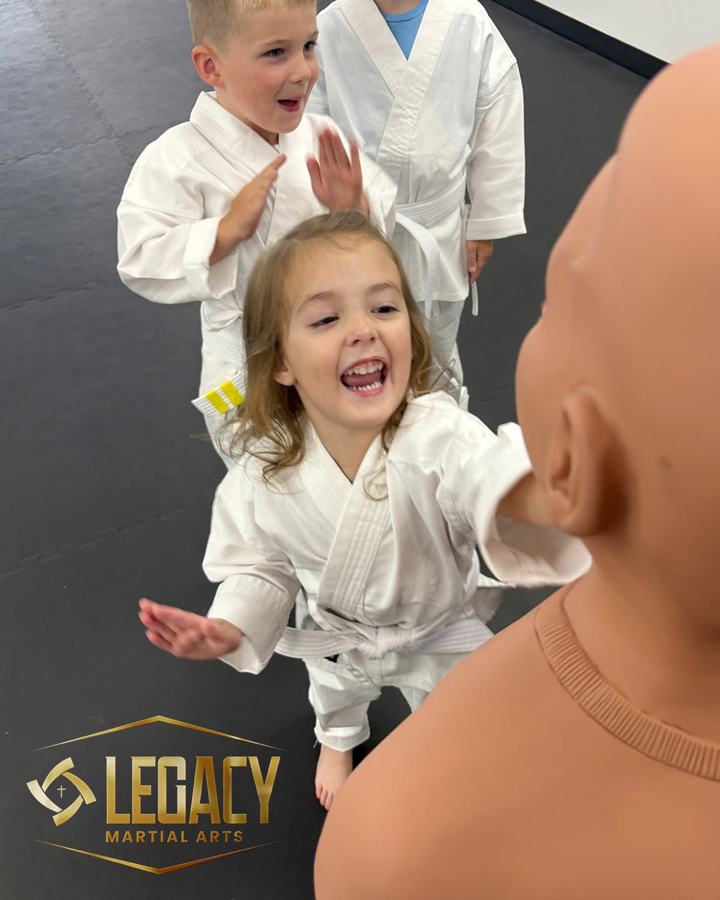
They call for one of these. Every one of them is a real reason, and every one of them is trainable.
We don't ask him to sit still for thirty minutes. We ask for eight seconds on a spot, then movement, then eight seconds again — and we stretch it over months.
Line up. Wait your turn. Listen to an adult who isn't your parent. Try something in front of other kids. That's the actual syllabus here.
Following a direction the first time is a trainable skill, and it's most of what this class is. It's the change parents report first.
Small classes, a predictable routine, and no pressure to perform on day one. Plenty of our Tigers watched from the edge for their first few visits.
Thirty minutes of structured movement — balance, coordination, agility — that has a beginning, a middle and an end. Tired in a useful way.
Not a sibling's activity, not a group he was signed up for. A thing he's known for, by name, by adults who are pleased to see him.
Nothing lasts long enough to lose them. Same order every single time, because at this age predictability is what makes a child brave.
Line up on their own spot. It's the first instruction of the class and for a lot of three-year-olds it's the hardest one.
Movement disguised as a game. Running, hopping, freezing on command — that last one is self-control training and they have no idea.
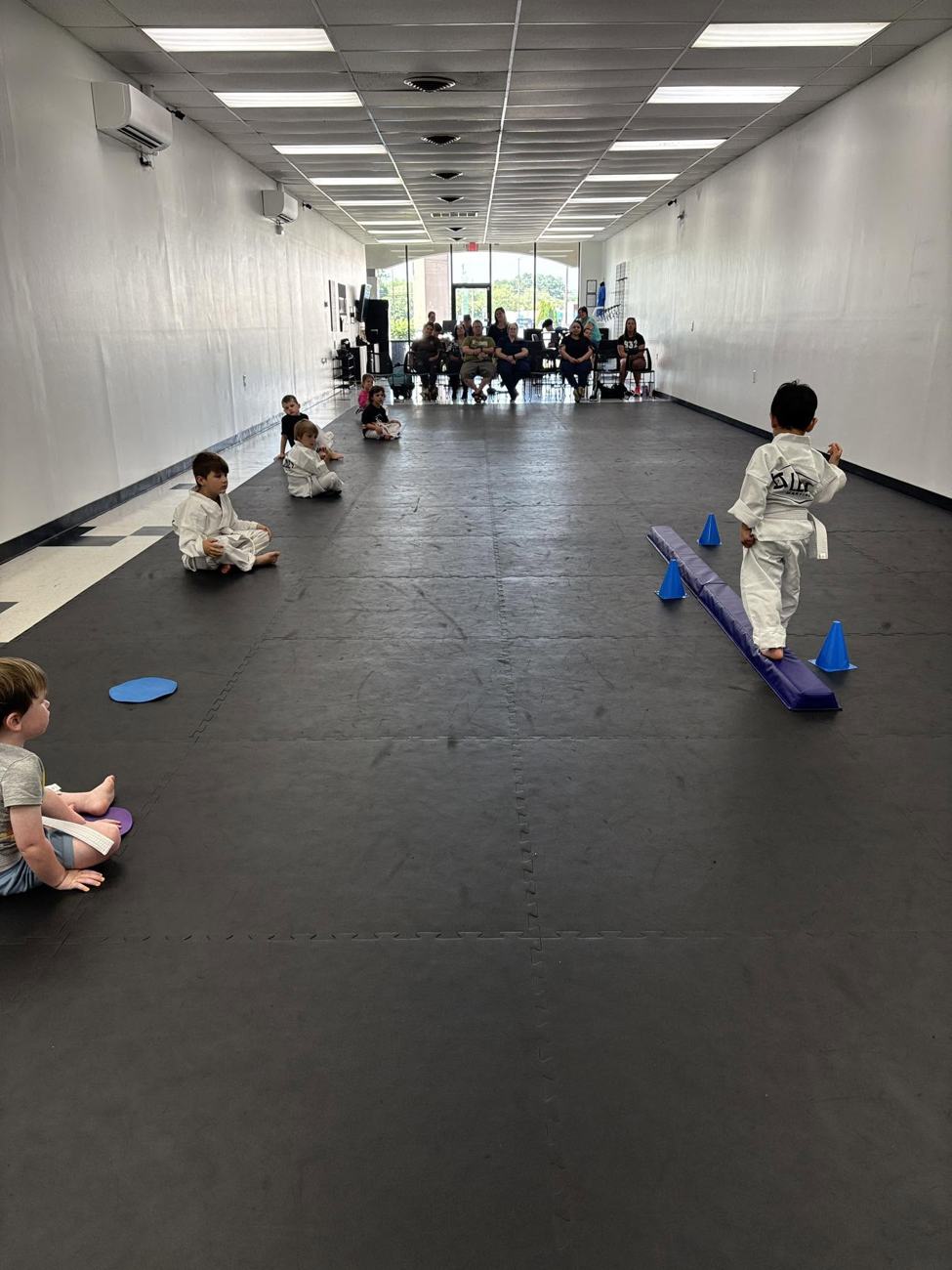
Balance beam, cones, agility ladder, targets. Small groups, constant turns, an instructor at each station so nobody stands around waiting.
A proper stance, a proper punch, a proper block. Scaled to their body but not watered down — they can tell the difference and it's why they care.
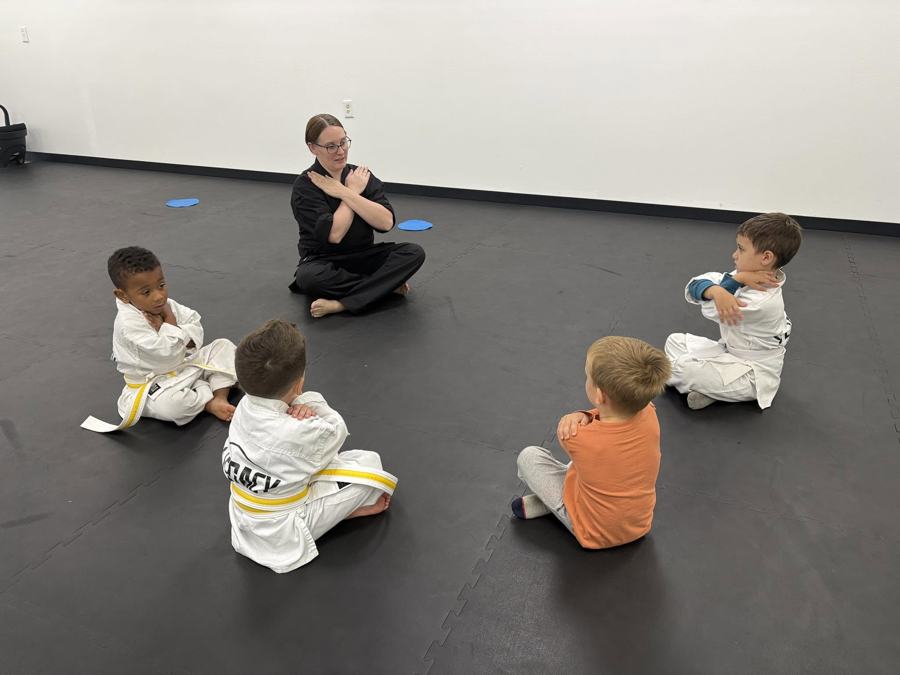
Sitting in a circle, talking about what we're working on this month — in words a four-year-old owns. “Respect means eyes on the person talking.”
Line up, bow, high five on the way out the door. They leave having finished something, which is the whole point.
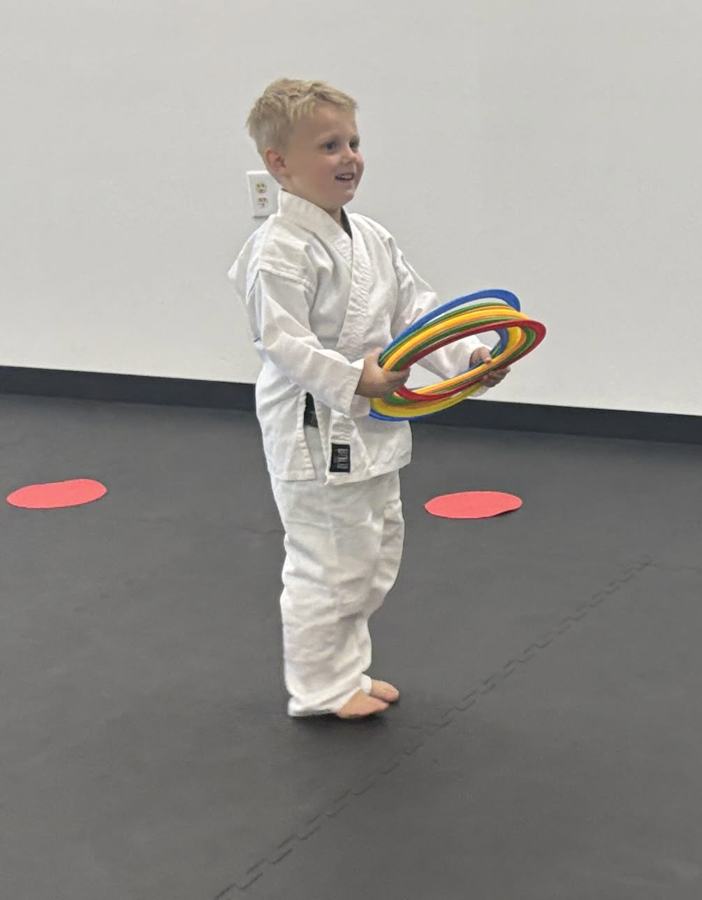
Sometimes, honestly, yes — and we'll tell you. A few three-year-olds aren't ready to be on a mat without a parent for thirty minutes, and there's nothing wrong with that. We'd rather you come back in six months than take your money for a year of frustration.
But most are ready, and they surprise their parents. The bar isn't “can they focus” — almost none of them can, that's the thing we're building. The bar is: can they separate from you for half an hour, and do they respond to an adult they don't know.
Bring them to an orientation and we'll find out together in forty-five minutes. That's genuinely the fastest way to answer it, and it costs nothing.
Underneath the punches, this is what a Tigers class is really working on — and what you'll start noticing at home.
An instruction is given once, then followed. It's repeated a few hundred times a month in an environment where following it is fun, and it transfers.
Freeze on command. Wait for your turn. Don't touch the equipment until you're told. Every game in the room is quietly a self-regulation drill.
Crossing the midline, single-leg balance, hopping, changing direction. The physical foundation everything else in childhood sits on.
Thirty minutes with a trusted adult who isn't you, in a room where they're known by name. For a lot of families this is the first time that's happened.
The class has a start, a middle and a bow at the end. A three-year-old who finishes something twice a week starts to think of themselves as someone who finishes things.
We don't do baby talk and we don't do drill sergeant. They get treated like a person who's capable, which is usually the first thing parents comment on.
Mrs. Kena holds rank in two martial arts and has spent her career working with young children and neurodivergent students. At this age that matters more than any belt on the wall.
A four-year-old who won't make eye contact, a three-year-old who melts down at transitions, a child with a sensory thing you haven't got a name for yet — none of that is new information on this mat. It doesn't get treated as a behavior problem and it doesn't get your child quietly moved to the back of the room.
If there's something we should know, put it in the notes when you book. We'd much rather be ready for your child on day one than figure it out on week three.
All public on our Google profile.
"The structure, lessons, and positive energy are exactly what we were looking for. It's amazing to see how much he's learning — not just in martial arts skills, but also in focus, respect, and confidence."
— Chelsea B. · parent of a 4-year-old"She also teaches them agility, coordination, and strength skills while instilling self control, self discipline, confidence and perseverance."
— Kara W. · parent"Instructors are caring and patient. We have finally found an activity that my child looks forward to."
— Patricia R. · parent
Long enough to do real work, short enough that they leave wanting to come back. Anything longer at this age is theater for the parents.
Seated viewing area with coffee. We're not a drop-off, and at this age we actively want you in the room seeing what we're working on.
Comfortable clothes they can move in. Barefoot on the mat. The uniform is handled once you enroll.
Twice a week is where the habit forms. Once a week at this age barely registers — we'll be honest with you about that.
Tigers feed into Dragons around age five. Not on a birthday — when they're ready for a longer class and a higher bar.
No enrollment windows, no waiting for a new session to begin. If it's a fit, they join the very next class.
We don't publish times online — classes are small and capped, and we'd rather tell you what's genuinely open for your child's age than send you a grid that's out of date.
Three is the youngest we take, in our Tigers class for ages 3 to 5. At that age the class is built around attention span, listening and coordination rather than technique, in thirty-minute sessions. Children move up to our Dragons class around age five, when they're ready for a longer class and a higher standard.
You stay. There's a seated viewing area with coffee at the front of the school and parents are welcome at every class. At this age we actively want you watching, because half the value is you knowing what we're working on so you can back it up at home.
It happens most weeks with someone, and it isn't a problem. A child who wants to watch from the edge is allowed to watch from the edge. We've never had a Tigers student who watched forever — they come in when they're ready, which is usually faster if nobody is pushing them.
Yes, please — we're not set up to change children, and you'll be in the building anyway. If your child is in the middle of training, just tell us and we'll keep an eye on it during class.
No. Tigers strike pads, targets and a standing bag — never each other. There's no sparring at this age, contact drills are instructor-led, and the mat is padded throughout. Partner contact is introduced years later, with full gear, only when a student is ready.
Very often yes. Our instructor's background is in special education and she specializes in young children and neurodivergent students. Your child trains in the regular class rather than being separated out. Tell us what would help before the first visit and we'll be ready for them.
Free, about 45 minutes, no obligation. They'll get on the mat in whatever they're wearing, and you'll know very quickly whether this is right for your family.